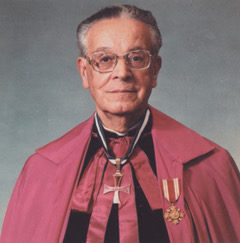
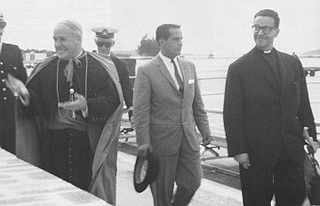
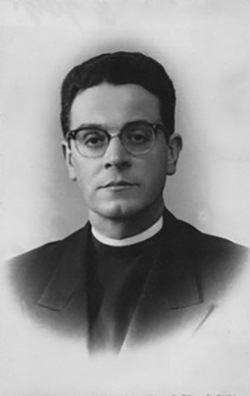
Much-loved Roman Catholic priest Filipe de Paiva Macedo spent much of his 24-year tenure in Bermuda fighting for the rights of Azorean contract workers. His activism brought about improved living and working conditions and helped overturn harsh immigration policies that prevented the wives and children of Azorean men from joining them in Bermuda.
Macedo arrived in Bermuda in 1958 to be a priest at St. Theresa’s Roman Catholic Cathedral in Hamilton. Unlike his Azorean parishioners, he was from mainland Portugal.
Roughly a thousand miles separate Portugal from the Azores, and mainland Portuguese were said to look down on Azoreans, their colonial underlings. But Macedo would earn the respect and devotion of Bermuda Azoreans.
He worked to establish a strong connection with the Azorean community, both at St. Theresa’s and at Vasco da Gama Club, which he frequently regularly.
Celebration
At St. Theresa’s, he established a Portuguese choir, formed a youth group and led marriage seminars. He encouraged parishioners to reconnect with their religious traditions, which in 1978 led to the celebration for the first time in Bermuda of a major Azorean festival, the Feast of Santo Cristo. While tending to the spiritual needs of Azoreans was straightforward, dealing with social conditions would prove to be more complicated.
Family was very important to Macedo. As one of 14 children, he could not fathom an immigration policy that would not allow wives and children of Azorean contract workers to join them in Bermuda. This policy did not affect other foreign workers, just Azoreans.
Historian Eduardo Pereira Medeiros, writing in 175 Years of Portuguese in Bermuda, said this “caused suffering and separation in Azorean families, couples not seeing their partners for many years, and children in the Azores, who had never seen their fathers, and men (but also women) who eventually started second families outside of marriage”.
Policy
Lobbying by political and business leaders, who relied heavily on Portuguese workers, brought about a change in policy in 1960. Men who had been working in Bermuda before 1957 could be joined by their wives and children under age 14. Those who arrived in Bermuda after 1957 were subject to the old policy.
Contracts for Azorean workers were covered by an agreement between Bermuda and Lisbon, Portugal, a situation that was unique to Azoreans, who were employed primarily in landscaping, agricultural and hotel jobs. The first agreement, which was deemed necessary by Lisbon because of abuses in the workplace, was ratified in 1957.
But there was no let-up in complaints about worker abuses after Macedo’s arrival. Workers shared with him stories of exploitation by unscrupulous employers. They complained of being forced to work 70-hour weeks with no days off, and a lack of sick and vacation pay. If they complained, some employers would threaten to send them back to the Azores.
Macedo’s unofficial role as advocate lasted four years. In 1962, the Lisbon government appointed him as vice-consul. While he did not have a good command of English, and required a translator, he proved to be an effective negotiator, as he pushed for higher salaries and better benefits.
Agreement
In 1964, a new agreement was thrashed out between Bermuda and Lisbon, which resulted in higher salaries and benefits that were in line with what other Bermuda workers, both Bermudian and expat, received. Wives could join their husbands who had been in Bermuda for two years. But they could stay for only 12 months, and had to return to the Azores for two years before rejoining their husbands. This caused more unhappiness and stress as wives did not want to leave when the year was up and some tried to remain illegally. There were complaints that wives of men who worked for prominent employers were allowed to stay.
In 1966, Macedo received support from Bermuda’s clergy. This representative group, who included the Anglican Bishop and the head of the AME Church, presented a petition to the Governor, saying that the separation of Azorean families was “contrary to natural justice and Christian morality and is not in the public interest”. The petition also stated that the policy unfairly discriminated against Azoreans as it did not apply to other foreign workers.
Debates
Macedo continued to press the Bermuda government for a better deal. In October 1967, he went public about poor working conditions Azoreans had to endure, saying they were “working like horses” with no overtime pay and poor housing. He said some employers took advantage of their limited English and had them sign secret contracts that bore no relationship to contracts approved by the two governments. And he announced that Lisbon had stopped the flow to Azorean workers to Bermuda from August 1967—a situation that would remain in effect for a year.
Then as now, the immigration issue led to heated debates in Parliament. Some of the issues raised were concerns about the ability of the education system to deal with the needs of Portuguese-speaking students, and according to author Eduardo Medeiros, “fear of the (higher) fertility of Portuguese women”.
Inevitably, in Bermuda, with its often duelling three main ethnic groups, white (Anglo), Black and Portuguese, there were the racial dynamics. Opposition Progressive Labour Party Members of Parliament queried why workers could not be brought in from the Caribbean, which had a majority Black population.
Arrivals
Macedo’s tactic of stopping new arrivals had the desired result. In August 1968, a new agreement went into effect. It allowed wives to join husbands after six months if they had no children, and after two years if there were children.
The agreement also put in place better working conditions. With the ban on new arrivals lifted, in October 1968, 50 Azorean workers received the green light to move to Bermuda.
In 1972, a new agreement restricted Azorean workers to four job categories. It was not until 1982 that the distinction between Azoreans and other overseas contract workers was dropped.
Macedo’s dogged determination earned him the devotion of Azoreans as well as official commendations. Interviewed by Bonnie Exell, for her profile of Macedo in the May 2000 issue of The Bermudian, close friend Elsie Martin said: “He figured that families should be together and that children should be brought up with their fathers. He was educated and made up his mind that the people were not going to be treated the way they had been.”
In 1964, Macedo was a recipient of the Pope’s Medal. In 1968, he received a commendation from the Portuguese government. When he retired in1981, he was appointed honorary monsignor. He could look back on two decades of activism both secular and spiritual, having performed more than 1,000 marriages and baptisms.
He retired to his birthplace, Ruivães, in northern Portugal, but Bermuda would always hold a special place in his heart. His home was called Villa Bermuda, and painted tiles of Bermuda scenes, including St. Theresa’s Cathedral, graced the tower of his home.
He celebrated his golden anniversary as a priest in 1990, and died two years later at age 78. Bermuda Azoreans never forget him. In 2012, he was honoured posthumously by the Roman Catholic Church with its Peace and Social Justice Award.
The Bermuda Government’s cautious approach to granting permanent residency and Bermuda status would ensure that immigration would remain a contentious issue up to the present day.
In the 1980s and 90s, Azorean and other foreign workers would take up the fight for the rights of long-term residents. Macedo paved the way for 1990s Azorean activists such as Anna Faria. Author Medeiros wrote that Macedo was one of the most important figures in the Portuguese community during the sixties. Azorean by adoption, he was “tireless in fighting for the rights of Portuguese immigrants.”

|